

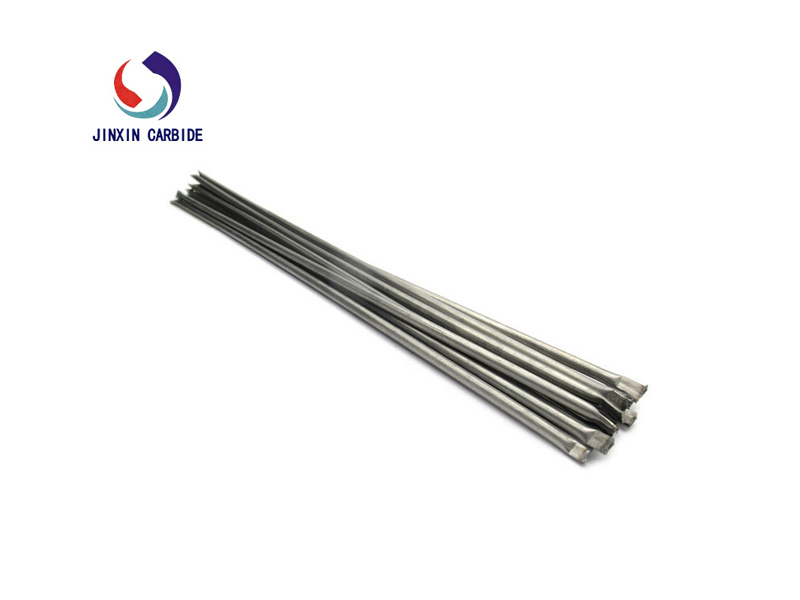
Tungsten Carbide Composite Rod
Share with
Product Description
Product introduction
The cemented carbide overlay welding electrodes are made from granular sintered cemented carbide mixed with an elastic base alloy. They are coated with a special layer of flux and colored to indicate the grain size. The grains of the sintered cemented carbide consist primarily of tungsten carbide with cobalt, achieving a hardness of HRA89-91; the flux metal is either nickel or copper, offering a tensile strength of 690 MPa and a hardness of HB≥160.
Cemented carbide grains utilize sintered tungsten carbide material, with an optimized cobalt content carefully controlled between 5% and 12%, ensuring the wear resistance of the grains as well as their strong bond to the metallic base. In the nickel-copper alloy matrix, copper accounts for between 30% and 35%, resulting in a density of 14.8 g/cm³ and creating a robust supporting structure with a tensile strength of 690 MPa. The special flux coating helps minimize oxidation reactions during the overlay process, ensuring a uniform and orderly distribution of the alloy grains.
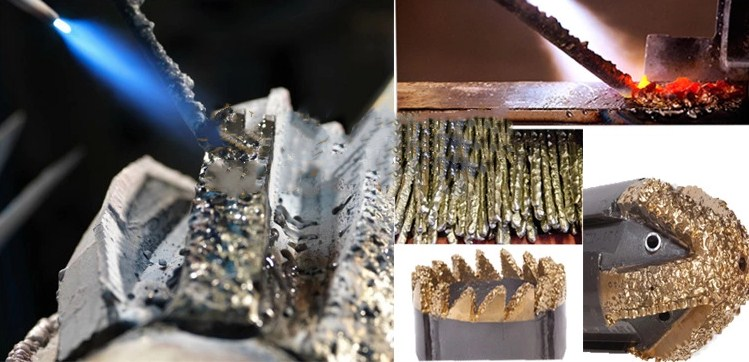
Cemented carbide electrodes are primarily used for overlay applications in industries such as oil, mining, coal extraction, geology, and construction—on components that experience severe wear or also require cutting functions. For example: milling shoes, wear shoes, aligners, reamers, drill rod joints, hydraulic cutters, scraper blades, coal mill cutter blades, core drills, pile drills, twist drills, and more.
Main dimensions
| Serial number | Binding agent | Cemented carbide grains (millimeters) | Total length (mm) |
| 1 | Copper/Nickel | 1.6–3.2 | 450/360 |
| 2 | Copper/Nickel | 3.2–4.8 | 450/360 |
| 3 | Copper/Nickel | 4.8–6.4 | 450/360 |
| 4 | Copper/Nickel | 6.4–8.0 | 450/360 |
| 5 | Copper/Nickel | 8.0–9.5 | 450/360 |
| 6 | Copper/Nickel | 9.5–11 | 450/360 |
Method of use
Before overlaying, the oxide layer on the workpiece surface must be removed using an abrasive grinding wheel and degreased with acetone. During the preheating phase, a neutral flame is used to heat the material up to 600–700°C, keeping the flame nozzle 25 mm away from the workpiece surface. In the overlaying process, the base alloy is first melted to create a molten pool, after which cemented carbide grains are evenly spread, ensuring the overlay thickness remains uniform—between 3 and 5 mm in a single layer. Once the overlaying is complete, the area should be covered with insulating material and allowed to cool slowly until it reaches ambient temperature.
Category:
Cemented Carbide Hardfacing
Key word:
Tungsten Carbide Composite Rod
Tungsten Carbide Brazed Rod
Hadfacing Rod
Product consultation
Attention: Please leave your contact information, and our professionals will reach out to you as soon as possible!
Recommended products


Contact us
Phone:+86 133-9733-9096
Mailbox:13397339096@ojinxin.com
WhatsApp:+86 133-9733-9096
Address: Jiade Industrial Park, Zhuzhou City, Hunan Province, China
The inventory of anti-slip nails is in stock, along with the efficient development of diverse products and superior quality.
Navigation
Request a quote
Copyright © Zhuzhou Jinxin Cemented Carbide Group Co., Ltd
This site supports IPv4 and IPv6.
Powered bywww.300.cn Changsha

