

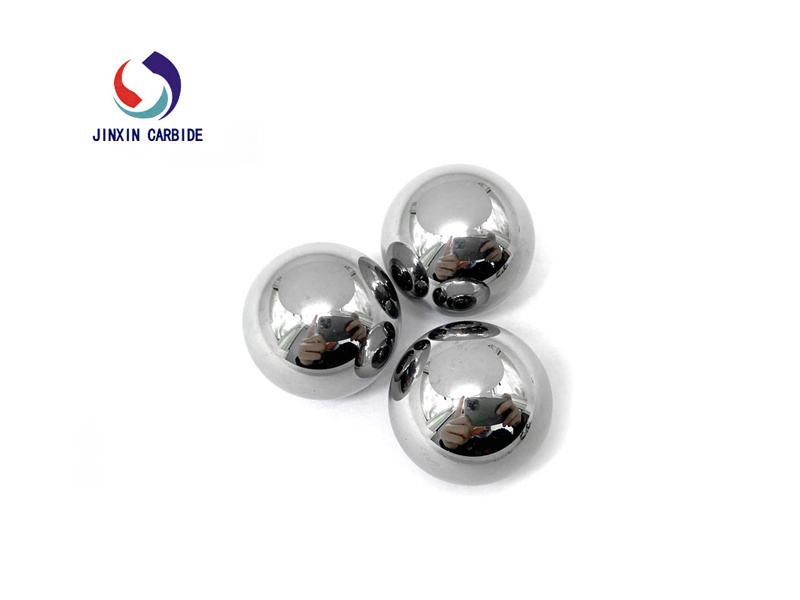


YG6 G10 High-hardness Polished Tungsten Carbide Balls
Share with
Product Description
Tungsten carbide balls, commonly known as tungsten steel balls, are spherical, engineered products made by sintering micron-sized powders of metal carbides such as tungsten carbide (WC) and titanium carbide (TiC) as the main components, with the addition of binders like cobalt, nickel, or molybdenum, using powder metallurgy processes in vacuum furnaces or hydrogen-reduction furnaces.
Tungsten carbide ball production process
It primarily includes steps such as powder manufacturing, formulation of the recipe according to application requirements, wet milling, mixing, grinding, drying, sieving, addition of a forming agent, redrying, sieving to obtain the mixed material, granulation, cold isostatic pressing, shaping, sintering, shaping (final product), packaging, and storage.
Characteristics of tungsten carbide balls
- high hardness: Hardness ≥90.5 HRA, significantly higher than that of standard steel balls.
- High wear resistance: Wear resistance can be tens to hundreds of times greater than that of traditional steel balls, and it can maintain its shape and dimensional stability during long-term use.
- excellent corrosion resistance: It has strong resistance to acids, alkalis, and other chemical substances and can operate reliably in corrosive environments.
- Strong resistance to bending It has high strength and toughness, is not prone to bending deformation, and can withstand considerable external forces.
Tungsten carbide ball classification
According to the processing technology, there are rough grinding balls, coarse grinding balls, fine grinding balls, and so on.
By application: includes bearing balls, valve balls, non-magnetic balls, Monel balls, through-hole balls, measuring balls, color-scratching balls, and pen balls, among others.
Common degrees
Common grades include the YG, YN, YT, and YW series. Among these, cemented carbide balls of grade G6 contain 94% WC and 6% Co, with a hardness of 91 HRA and a density of 14.6–15.0 g/cm³. Cemented carbide balls of grade G8 contain 92% WC and 8% Co, featuring a hardness of 89 HRA and a density of 14.4–14.8 g/cm³.
Application field of tungsten carbide balls
In the field of mechanical manufacturing:
It is used in the manufacturing of key components such as precision rods and ball screws, enhancing the accuracy and lifespan of equipment.
In the petrochemical field:
It is applied in oilfield equipment, valves, pumps, and other devices, and can withstand corrosion and wear from media such as oil, gas, and water.
In the field of instrumentation:
such as sensors, transmission components, etc., in measuring instruments, ensuring the precision and stability of the devices.
- aerospace sector:
It is used in the manufacturing of components for aviation engines and aircraft, meeting their requirements for use under extreme conditions such as high temperature, high pressure, and high speed.
Specifications and precision of the tungsten carbide ball
The minimum diameter can reach 0.3 millimeters, and the production precision grade can achieve G3–G3000. Non-standard customization can be carried out according to customer requirements, ensuring compliance with the size and precision needs of various application scenarios.
Category:
Carbide Ball
Key word:
Tungsten Carbide Ball
YG6 Carbie Ball
Product consultation
Attention: Please leave your contact information, and our professionals will reach out to you as soon as possible!
Recommended products


Contact us
Phone:+86 133-9733-9096
Mailbox:13397339096@ojinxin.com
WhatsApp:+86 133-9733-9096
Address: Jiade Industrial Park, Zhuzhou City, Hunan Province, China
The inventory of anti-slip nails is in stock, along with the efficient development of diverse products and superior quality.
Navigation
Request a quote
Copyright © Zhuzhou Jinxin Cemented Carbide Group Co., Ltd
This site supports IPv4 and IPv6.
Powered bywww.300.cn Changsha

